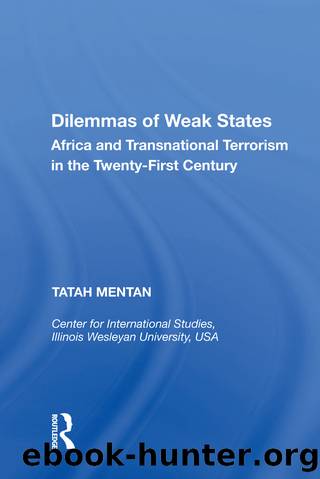
Dilemmas of Weak States: Africa and Transnational Terrorism in the Twenty-First Century by Tatah Mentan
Author:Tatah Mentan [Mentan, Tatah]
Language: eng
Format: epub
Tags: Public Policy, Political Science, General, Economic Policy
ISBN: 9781351159906
Google: I_hADwAAQBAJ
Goodreads: 36984395
Publisher: Routledge
Published: 2004-10-30T00:00:00+00:00
Elusive borders and terrorism
There have been debates about the relationship of individual African states to transnational organizations or non-state actors. These actors may be violent or non-violent ones. However, views range from those who emphasize the degree to which states are manipulated by these organizations to serve their individual and collective interests to those who emphasize the degree to which states are autonomous actors who deal with international organizations as one interest group. There has also been debate about the degree to which these organizations could escape control by the state machineries; and there are many who are arguing that their ability to do this has increased considerably in recent decades with the so-called globalization.
In addition, there have long been debates about the relationship of so-called sovereign states to each other. Views range from those who emphasize the effective sovereignty (Krasner, 2001) of the various states to those who are cynical about the ability of so-called weak states to resist the pressures (and blandishments) of so-called strong states. This kind of debate is apparently archaic. For example, the most horrendous, reprehensible and unexpected attacks on the twin towers of the World Trade Center, the Pentagon and the reportedly abortive attempt on the White House stunned and traumatized the entire American nation and shook the peace loving countries of the world. These meticulously planned and executed attacks caused enormous destruction of men and material, which the Americans could never have imagined even in the wildest of their dreams. These attacks made it abundantly clear that no country, however powerful, is invulnerable to desperate and unpredictable terrorist onslaughts.
The Organization of African Unity (OAU) expressed 'to the Government and people of the United States the full solidarity and the deepest condolence of the OAU and the entire people of Africa over this tragedy which affected not only the people of the United States but humanity as a whole.' This statement was contained in the OAU communiqué of September 20, 2001. The prompt reaction of the OAU was based on the fact that Africa is now unfortunately the world's soft underbelly for global terrorism. Al Qaeda and other terrorist cells are active throughout East, Southern, and West Africa, not to mention North Africa. These terrorist organizations hide throughout Africa. They plan, finance, train for, and execute terrorist operations in many parts of the continent, not just from the Sudan and Somalia.
Terrorist organizations take advantage of Africa's porous borders, weak and corrupt law enforcement and security services, and nascent judicial institutions to move men, weapons, and money around the globe. They also take advantage of poor, disillusioned populations, often with religious or ethnic grievances, to recruit for their jihad against their targets. In fact, terrorist networks are exploiting Africa thoroughly. And in the process, they are directly threatening the national security of declared target groups such as the United States and Israel. For the ordinary African, 'Is it not only death and hardship?' (Seequeh, 1996, p. 9).
The omnipresence of 'swamps' for breeding terrorists explains why
Download
This site does not store any files on its server. We only index and link to content provided by other sites. Please contact the content providers to delete copyright contents if any and email us, we'll remove relevant links or contents immediately.
| Anthropology | Archaeology |
| Philosophy | Politics & Government |
| Social Sciences | Sociology |
| Women's Studies |
The Secret History by Donna Tartt(19088)
The Social Justice Warrior Handbook by Lisa De Pasquale(12190)
Thirteen Reasons Why by Jay Asher(8909)
This Is How You Lose Her by Junot Diaz(6886)
Weapons of Math Destruction by Cathy O'Neil(6279)
Zero to One by Peter Thiel(5802)
Beartown by Fredrik Backman(5754)
The Myth of the Strong Leader by Archie Brown(5507)
The Fire Next Time by James Baldwin(5444)
How Democracies Die by Steven Levitsky & Daniel Ziblatt(5218)
Promise Me, Dad by Joe Biden(5153)
Stone's Rules by Roger Stone(5087)
A Higher Loyalty: Truth, Lies, and Leadership by James Comey(4963)
100 Deadly Skills by Clint Emerson(4925)
Rise and Kill First by Ronen Bergman(4788)
Secrecy World by Jake Bernstein(4753)
The David Icke Guide to the Global Conspiracy (and how to end it) by David Icke(4718)
The Farm by Tom Rob Smith(4509)
The Doomsday Machine by Daniel Ellsberg(4490)
